This example creates a nesteddictionary to store details of multiple students. Each student is added as a key and their information (name, age, grade) is stored in an inner dictionary.
In this article, you’ll learn about nesteddictionary in Python. More specifically, you’ll learn to create nesteddictionary, access elements, modify them and so on with the help of examples.
PythonNestedDictionaries: Complete Guide Nesteddictionaries are essential when you need to organize complex, hierarchical data in Python. They’re particularly useful for working with...
By understanding the fundamental concepts, usage methods, common practices, and best practices, you can effectively use nesteddictionaries in your Python programs.
This tutorial demonstrates how to create and use nesteddictionaries in Python. Learn how to access, modify, add, and delete entries from nesteddictionaries with practical examples and clear explanations.
There’s a lot that goes into working with nesteddictionaries in Python. You can access individual values, change them, add new rows, delete old ones, merge multiple dictionaries, iterate over them, and even convert the entire thing to a Pandas DataFrame or JSON file.
JSON Data: Nesteddictionaries naturally map to the structure of JSON data, making them essential for working with APIs and web services. In this tutorial, we’ll explore how to create, access, and manipulate nesteddictionaries in Python.
We are given a nesteddictionary and our task is to access the value inside the nesteddictionaries in Python using different approaches. In this article, we will see how to access value inside the nesteddictionaries in Python.
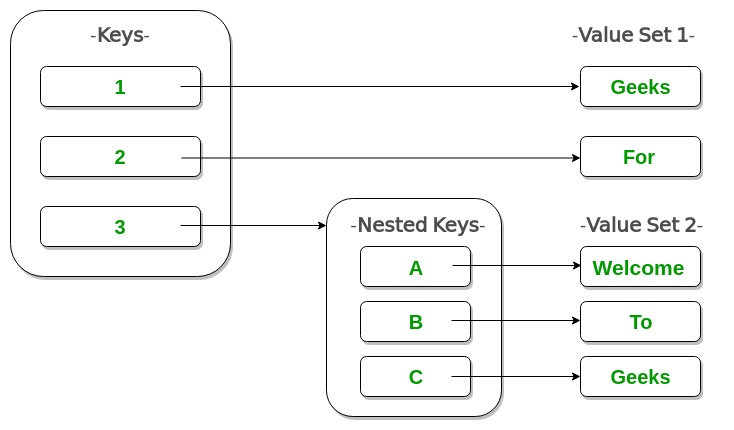 This example creates a nested dictionary to store details of multiple students. Each student is added as a key and their information (name, age, grade) is stored in an inner dictionary.